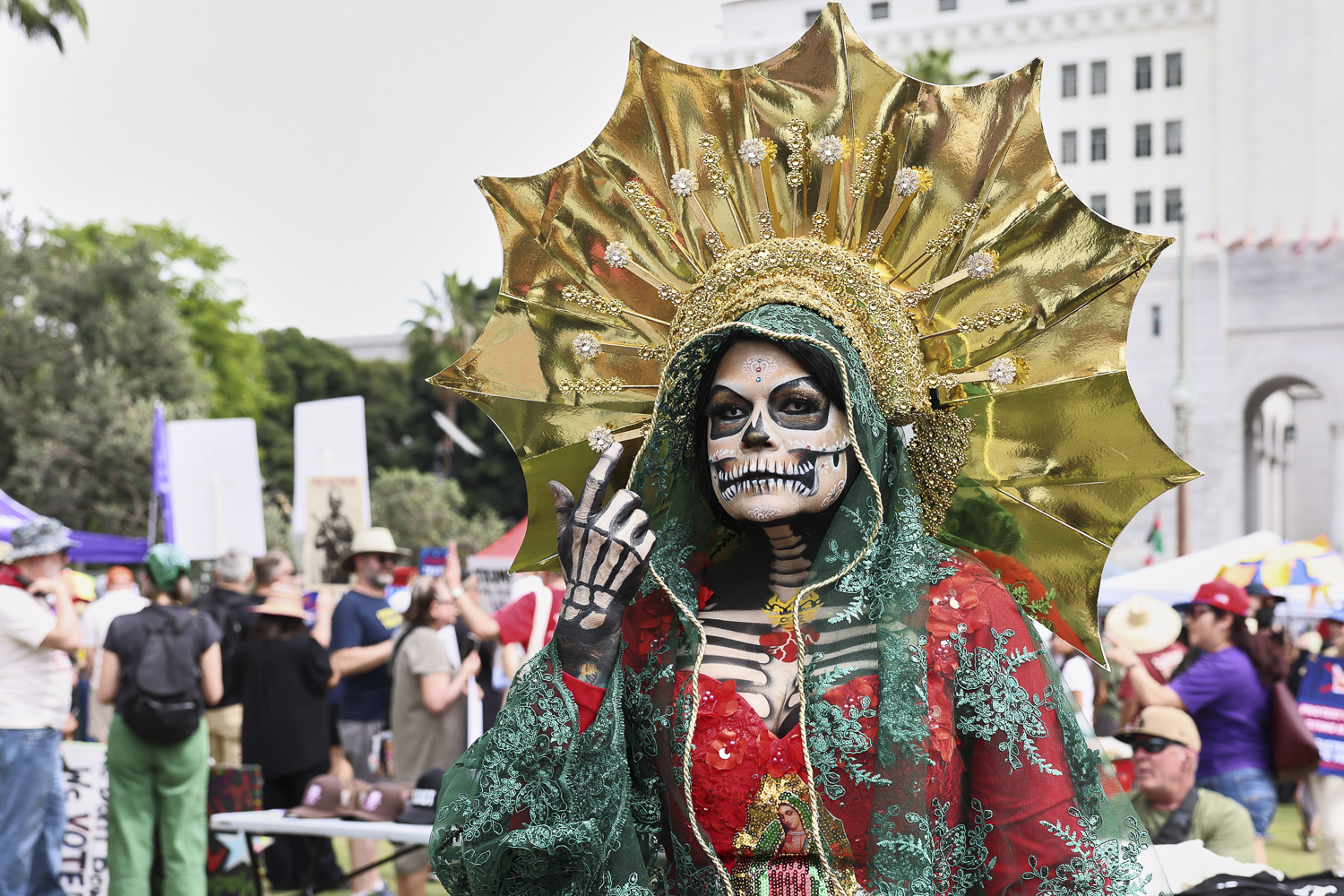
Beneath the feathered hat, La Catrina’s resistance connects her iconic, satirical origins to her enduring modern power as a symbol of defiance.
On the lawn near City Hall, a line of Catrinas brought their unique beauty, vibrant energy, and excitement to the crowd, who were fired up at the “No Kings” protest at the Gloria Molina Grand Park in Downtown Los Angeles on March 28, 2026.
They moved with grace, showcasing their bright fuchsia outfits that brought a cheerful splash of color to the scene. Demonstrators and photographers eagerly captured the moment, all eyes on them, leaving a warm, unforgettable impression.
Across their beautiful skirts, symbols of political defiance and resilience shone, representing hope and strength in the fight against injustice.
The Catrinas walked around with gentle movements, each showcasing a unique model. Their faces were painted with intricate skull designs, and they wore floral crowns and flowing dresses, moving silently among the demonstrators.
People often recognize and celebrate Catrinas during the joyful “Día de Muertos,” highlighting their special significance in this meaningful tradition. Recently, Catrinas have descended from altars and slipped out of holiday parades, now marching through the streets as living protest figures rather than symbols of remembrance.
From Satire to a Symbol of Resistance
Prominent Chicana artist Maria Flores, known as La Muerte Maria from East Los Angeles, has received widespread acclaim for her protest-themed Catrinas.
“My Catrina Project began as a way to merge art, culture, fashion, and storytelling into a single living expression,” Flores said. “As a proud Chicana born and raised in Los Angeles, I am deeply connected to my roots, my community, and the experiences that shaped me growing up in East L.A. and South Central.”
Flores began creating wearable art pieces inspired by the elegance and symbolism of La Catrina, and over time, the project grew into something bigger, she said. “Each look became a statement piece — handcrafted garments, headpieces, airbrush makeup, protest-inspired fashion, and cultural storytelling, all combined into one visual experience.”
The project grew organically through community events, cultural celebrations, performances, marches, and collaborations with artists, photographers, and models. “What began as creating a single character eventually evolved into building an entire visual movement of Catrinas that represent culture, resistance, beauty, history, and empowerment,” Flores said.
Among the thousands of demonstrators passionately chanting and proudly holding signs for justice, dignity, and the protection of immigrant families, the Catrinas quietly stand out—silent yet deeply expressive.
La Catrina, a symbol deeply embedded in Mexican culture, has been reinterpreted as a political figure that speaks to social injustice, identity, and survival within immigrant communities. Once a satirical illustration mocking Mexico’s elite, La Catrina has evolved into one of the most recognizable symbols of Mexican identity. Today, she is used as a political symbol in demonstrations.
The Birth of La Catrina
La Catrina was created in the early 1900s by Mexican artist José Guadalupe Posada. He illustrated skeletal figures to highlight and criticize the social inequality and arrogance of the elite and wealthy Mexicans who saw themselves as European during Porfirio Diaz’s dictatorship.
“He was, in his own way, showing that we are all still bones underneath it all,” said Lily Martinez, also known as Lily La Catrina on her social media account. “That is what it means to me to dress as a Catrina. We’re ALL bones underneath it all, folks. We are all equal… documented or not, by color, gender, religion, or political views. We’re all the same. We’re all human,” she said.
Years later, Diego Rivera portrayed the figure as an elegant female skeleton in his murals, solidifying her significance in Mexican culture.
Over the years, La Catrina has become an iconic symbol of Día de Muertos, a vibrant, joyous holiday celebrated in November. The unique characteristic of the celebration is that, rather than mourning, it is a colorful celebration of life and family, in which the living welcome back the spirits of deceased loved ones for a brief reunion.
Many cultures view death as something to approach with respect, though it can feel intimidating or even taboo. For Catrina, it represents the idea that death unites everyone regardless of wealth, race, or social status. And in Los Angeles, that meaning has grown to play a bigger role in politics.
La Catrina as Political Language
At recent immigration and No Kings rallies in Downtown Los Angeles, Catrinas frequently lead marches. Activists and artists, such as Flores, have utilized the image to protest deportations and anti-immigrant rhetoric at these events.
Flores said that La Catrina carries powerful symbolism. “She represents mortality, dignity, ancestry, and the reminder that we are all equal in death, regardless of class or status,” she said. Flores wanted to expand that symbolism and bring her into modern conversations happening in the streets and communities today.
By combining protest themes with traditional Mexican imagery, Flores created a visual language that people immediately connect with emotionally. A Catrina dressed in resistance-inspired fashion walking through Los Angeles is impossible to ignore. “She sparks curiosity, conversation, reflection, and sometimes discomfort, and that is the power of art,” she said.
“My inspiration came from watching what was happening around me, including issues affecting our communities such as women’s rights, immigrant rights, education, cultural erasure, and social injustice,” she said. “I realized that art could speak loudly without saying a word.”
Immigrants and Mexican American communities have long used art, music, and public rituals to cope with grief and resist oppression.
La Catrina stands as a powerful symbol in activism, vividly emphasizing the strong connection between Mexican tradition and Mexican American identity. It illustrates how cultural pride and political resistance are deeply intertwined. La Catrina serves as a bridge between past and present, embodying the cultural memory of ongoing struggles.
Her presence at demonstrations provokes an immediate emotional response. She elevates the rally beyond mere politics, transforming it into a cultural act and a reclaiming of identity against policies that seek to erase it. Her striking, haunting presence highlights how Trump’s policies have tangible human impacts on local communities.
More Than a Costume
When a Catrina marches and protests on the streets of Los Angeles, a new meaning emerges.
During the “No Kings” march from Pershing Square in Downtown Los Angeles to City Hall, participants held signs saying, “No Human Being is Illegal.” The Catrinas at the front moved slowly, in contrast to the urgent chants from behind.
“When a Catrina appears on the streets as part of a protest, she transforms from a traditional cultural figure into a living symbol of resilience, memory, and resistance,” Flores said.
Public space has long been linked to activism, identity, and cultural expression in Chicano communities. Flores notes that witnessing a Catrina stroll through the streets creates a powerful contrast in which beauty intertwines with dissent and elegance combines with defiance.
“She becomes a reminder of those who came before us, those we have lost, and those still fighting to be seen and heard,” she said. The image challenges people to rethink. It shows that resistance can be artistic, feminine, cultural, spiritual, and deeply rooted in heritage.
This blend of art and activism is essential for communities, as it turns political debates into emotionally impactful stories. It fosters empathy, unites them, and challenges the status quo. La Catrina stands out amid the noise. She is immediately recognizable, firmly grounded in tradition, and impossible to overlook.
The symbolism is also a direct response to the human cost of enforcing immigration policy and to the unprecedented rise in the toll of deaths in immigration detention facilities, framing the Catrina as a reminder of lives lost.
During marches, some participants carry photos of relatives lost in immigration raids or of loved ones who died in custody; the Catrina transforms from a mere costume into a symbol and a witness.
Each Catrina embodies a Unique Emotion and Story
Over the years, Flores has created many Catrinas, each embodying a distinct story, message, and personality. Some are inspired by Adelitas and revolutionary women, while others reflect Indigenous origins, Chicano culture, Papel picado traditions, lowrider culture, lucha libre, social justice movements, or themes of feminine power.
One of her most notable works featured over 4,500 individually attached miniature Flor de cempasúchil, symbolizing remembrance, devotion, and the effort to preserve culture through art, Flores explained.
“Some honor ancestry and tradition, while others speak about identity, empowerment, visibility, and resistance,” Flores said. “Together, they form a collective visual archive of my experiences as a Chicana artist and educator in Los Angeles.”
Flores mentioned that each piece embodies her spirit, effort, and story. “However, one of my favorites is my large statement Catrina, which features an oversized hat inspired by José Guadalupe Posada’s original imagery of ‘La Calavera Garbancera,” she said.
For her, that piece became intensely personal, representing transformation, visibility, and fearlessness. The process of constructing it by hand—shaping the structure, designing the wardrobe, and developing the full character—challenged her creatively and emotionally.
“It also became a symbol of reclaiming space as a Chicana artist,” Flores said. “When people see that piece, they stop, stare, photograph it, and start conversations. That is exactly what I want my work to do — create impact and connection.”
Las Catrinas on the streets of Los Angeles make a strong statement: a refusal to be ignored in a city shaped by immigrants.
“I want people to understand that my work is not just about costumes or makeup. It is about storytelling, cultural preservation, visibility, and dialogue through art,” Flores said.
As an artist, educator, and Chicana woman from Los Angeles, Flores believes that creativity can both unite people and challenge systems, inspiring change. “My Catrinas are extensions of community, history, activism, and imagination. I hope people see themselves reflected in the work and feel inspired to celebrate their roots, stories, and voices,” she said.
\What began as a satirical sketch in the 1900s, highlighting class inequality, has blossomed into a worldwide cultural symbol. Now, walking through the lively streets of Los Angeles, where immigrant voices echo with hopes for recognition and justice, La Catrina returns—graceful, silent, and impossible to overlook.


- Juan Mendoza