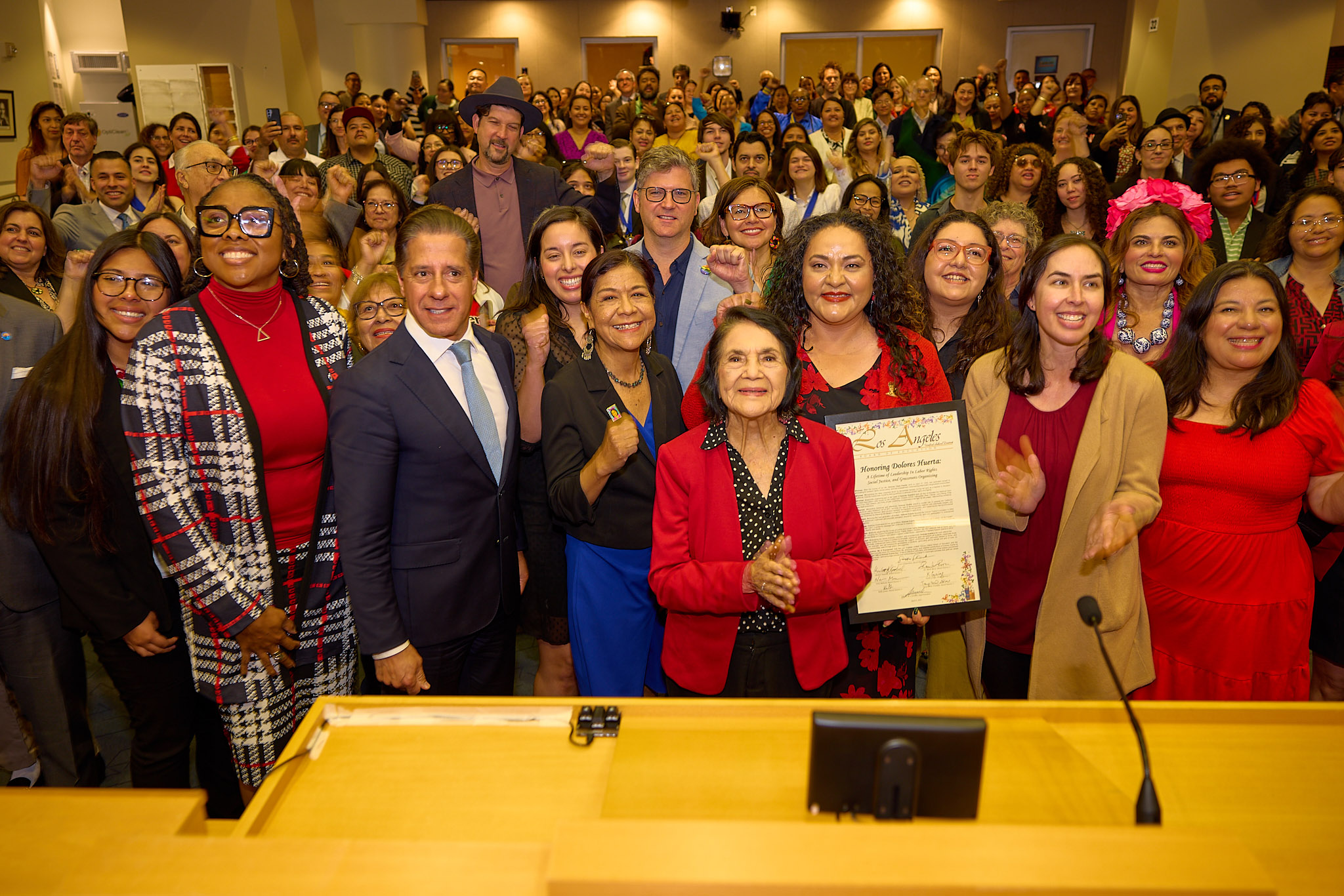
Dolores Huerta forever transformed the landscape for workers who feed America.
It is Dolores Huerta — the legendary labor and civil rights leader who proudly proclaimed, “Si Se Puede,” which means “Yes, we can,” and the Los Angeles Unified School District honored her for her work during a ceremony in April.
Scores of community activists, Huerta’s family members, friends, teachers and students gathered at the LAUSD headquarters for a Board of Education meeting to participate in a historic event to celebrate her life and contributions.
All board members attended, including Superintendent Alberto Carvalho and Dr. Rocio Rivas, the Board of Education member for District 2. Rivas introduced the idea and authored the resolution.
Excitement and emotions ran high among attendees as they witnessed 95-year-old Huerta enter the auditorium. The crowd welcomed her with an ovation, as they chanted “Si Se Puede.”
“I have the distinct honor of introducing a resolution that uplifts the legacy of one of the most powerful voices in the fight for labor rights, social justice and dignity, the beautiful Dolores Huerta, as a lifelong organizer, educator, and civil rights leader,” Rivas said.
Huerta raised 11 children as a single mother while she organized strikes and boycotts. She began to confront agricultural giants about conditions for farmworkers as far back as the 1950s. The civil rights leader continues her fight for the underprivileged, and the LAUSD honored her with an official day.
Huerta Empowers Communities
The activist has never stopped fighting to empower communities that have long been silenced and sidelined. She co-founded the United Farm Workers, established the Dolores Huerta Foundation, and she inspired the world to act.
“I admire Dolores Huerta for her courage and lifetime commitment to justice,” said Jazmine Garcia, community affairs deputy, from Dr. Rivas’ team. “At a young age, she began to organize to uplift the marginalized community.”
“We need to teach the children that we are one human race, that we are homo sapiens, and our human race came from Africa,” Huerta said. “I think one big way that we can get rid of racism once and for all is that people need to understand that we are all Africans of different shapes and colors.”
— Dolores Huerta, civil rights icon
On many occasions, the opposition attempted to silence Huerta for her advocacy and organizing for justice.
“Dolores Huerta is regarded as a giant of the civil rights movement,” Garcia said. “She came across hate and pushback, yet she continued to fight. At 95 years old, she speaks against racist policies and threats to our Constitutional rights.”
Huerta Pays Price for Activism
During a peaceful protest in San Francisco in 1988, the police brutally beat Huerta and cracked 11 ribs and ruptured her spleen. She collapsed on the pavement. Despite the abuse and pain, she did not stop and continued the fight. After five years of nationwide boycotts, Huerta negotiated the first-ever contract for farm workers with the multimillion-dollar agricultural industry.
“When I think of you, Dolores, I think that you can’t lead the people if you don’t love the people, and the love that you show to everyone in all places,” said David Goldberg, president of the California Teachers Association. “I want to honor you the way you have shown so much love to everyone, especially the most vulnerable people in our society.”
The working conditions improved, and pesticide protections were implemented; however, the true victory was that Huerta demonstrated to Americans that even the most marginalized and powerless individuals could organize and succeed. Because of her efforts, millions of previously invisible workers gained visibility.
Voices Rise for Huerta
“Her advocacy and her passion remind us that we are the change we can advocate for and believe in,” said Yolanda Cuevas, an LAUSD student.
The working conditions improved with time and effort. Companies implemented pesticide protections. Huerta showed Americans that even the most marginalized individuals could organize and succeed.
“This remarkable woman we are here to honor today lasted as a California public school teacher for a year; she left the worthy profession for far greater reasons than mine,” said Sarah Bradshaw, a consultant in management and labor relations. Bradshaw says she met Huerta and Cesar Chavez in the 1990s while she was working for a union. She considers it an honor.
“Little did I know that I would be blessed with this woman in my life for the next 35 years; thus, I refer to her with love and respect as ‘Dolores,’ and occasionally as ‘big D,'” Bradshaw said.“Dolores is bringing joy, compassion, love, healing, organizing, hope, faith, strength, persistence and a whole lot more to millions around the world,” Bradshaw said. “I’ll never forget the day a young woman walked up to her in San Diego, pulled up her sleeve, and showed Dolores the ‘Si Se Puede’ tattoo on her forearm.”Huerta acknowledged that teachers are burdened and have a great deal to teach, yet at the same time, public funding for education has been reduced.
“We have a difficult road ahead of us, and so we all have to keep working together and making sure we get the kind of community support that we need,” Huerta said to the audience. She called education “the savior of our democracy.”
“The only reason we are in trouble right now is that we have many people who are ignorant, uneducated, and do not know our country’s history,” Huerta said.

- Juan Mendoza

- Juan Mendoza